Daily Photo Parable

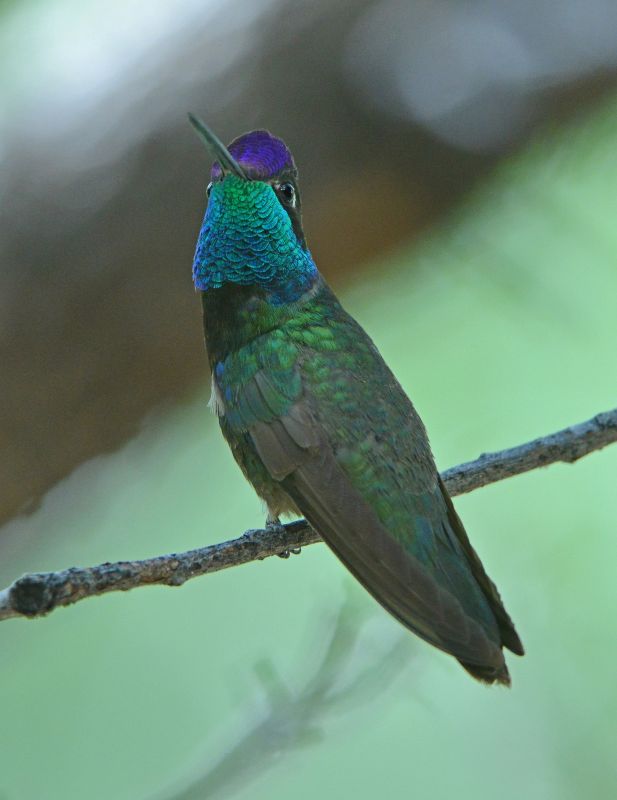
Rivoli’s Hummingbird        

Photo and Commentary ©2026 by Robert Howson
Tuesday, August 4, 2026

Our previous exposure or experience may cause us to make generalizations that may not necessarily be warranted.  We can use Rivoli’s Hummingbird, a species found in the Southwest, to illustrate this. Many of us have been dazzled by the flash of brilliant red on the throat of a hummingbird as the light seemingly set the bird on fire.  From this we might have concluded all hummingbirds share this same quality, but a look at Rivoli’s makes us realize red isn’t the only option available.  We’re amazed with their long, sometimes decurved bill which allows it to obtain nectar from flowers and assume others should be equally impressed.  While they may have been, the taxonomists elected to focus on another feature and placed them in the order Apodiformes, along with swifts, which simply means small feet.

And all hummingbirds are tiny, right?  Well, not really.  The largest is the Giant Hummigbird found in South America which is about the size of a Northern Cardinal.  The Rivoli’s is considerably smaller, but still the second largest of the 14 species known to breed in the United States. With its larger size comes slower wingbeats, almost slow enough for the human eye to see.  Sometimes it will even extend those wings and glide. Furthermore, not all hummingbirds are called hummingbirds, in fact only a little more than one fourth of the group is known by this name.  Consider the image created by these alternative names:  sabrewing, woodnymph, sapphire, coquette, fairy, mountain-gem, sunbeam, and the list goes on and on.

From these names, as well as from our own experience, it would be safe to assume this family of some 320 species is full of surprises. Remember, while our assumptions may at times be helpful, they may not always be right. In Christ’s parable of the workers who were hired at different times throughout the day, the workers who began work earlier wrongly assumed they would be paid more than those who worked just a short time.  (Matthew 20:10)   But Paul gives us an example where logic leads us to a proper assumption.  “The potter, for instance, is always assumed to have complete control over the clay, making with one part of the lump a lovely vase, and with another a pipe for sewage. Can we not assume that God has the same control over human clay?” (Romans 9:21-22 J.B. Phillips New Testament)
Sky

Photo and Commentary ©2026 by Shelley Schurch
Sunday and Monday, August 2 and 3, 2026

I don’t think I’m much of a desert person. (Although, I am definitely a dessert person, if you’re serving up homemade apple pie!) Heat, with or without humidity, makes me a whimpering, damp, limp rag of a person.

But sometimes I wonder if I could be very much a desert person, if I’d been born in cacti country, if that climate had formed my earliest memories.

I’ll never know. What I do know is that I’m a child of mountains and oceans, evergreens and eagles. You can imagine my delight when my Midwest prairie born-and-raised husband stepped out of the airplane that had brought us on his first trip to my beloved southeastern Alaska home, took a deep breath, and exclaimed how fresh the air was. This trip home was a gift from my parents on the occasion of our first anniversary, and I knew I had married well!

But what about his prairies? When he had driven me home to meet his family (a trip I took with a certain amount of trepidation), did I step out of the car in his parents’ farmhouse driveway and exclaim enthusiastically about my surroundings?

I’m sure I didn’t. I was too intent on looking and behaving like someone his family would welcome into their midst, because I was hoping to join their family in the near future.

We took many trips back to his South Dakota family in the ensuing months, and while I quickly grew fond of his people, it took me longer to warm up to his place. I was too aware of what wasn’t there — I missed my mountains. The land was so flat!

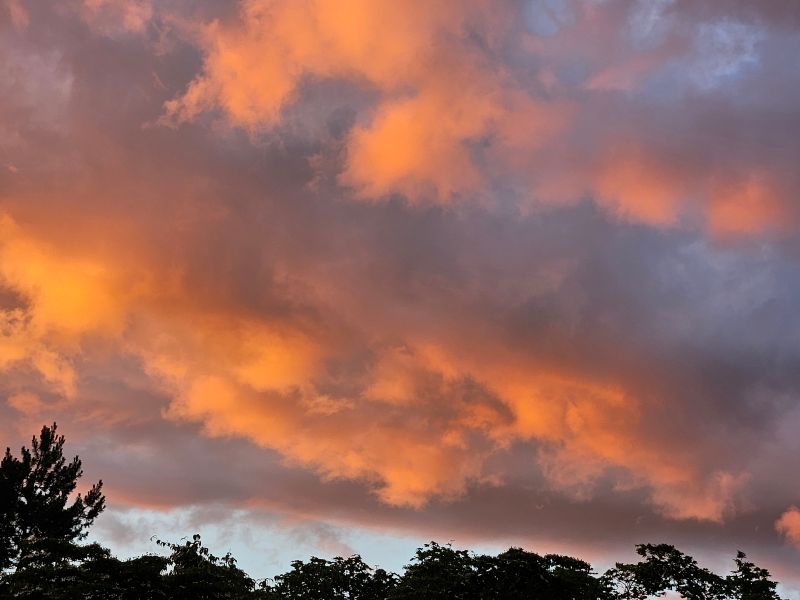
But I grew to realize that when you’re minus mountains, you have a whole lot more sky. And what a sky it could be! Thunderclouds could roll in and rustle up a storm adventure on short notice. Sunrises and sunsets had a vast canvas on which to paint their colors. My mother-in-law kept her eye on the sky and could accurately predict the weather as she sized up the look of the clouds and the direction of the wind.

I still remember a New Year’s Eve from over thirty years ago, when we drove back to his parents’ house after visiting friends who lived miles out in the country. It was a cold, clear night, and when we stepped out of the car at home we were dazzled by the multitude of stars overhead. The sky was thick with stars, and I once again forgave the prairies for not having mountains, since they put on such incredible displays of sky.

My photo above is not from South Dakota or Alaska. It’s from here, a few houses away from our home. We were returning from a walk at sunset, when the clouds became a magnificent masterpiece overhead.

A masterpiece that reminded me of our Master, and the beginning of a song David wrote about Him:

The heavens declare the glory of God;
the skies proclaim the work of his hands.
(Psalm 19:1 NIV)

No matter what state I’m in, literal or emotional, looking up calms my soul. It reminds me that there is a Master Artist who is also my Creator and Redeemer. And one of these days we will look up for the best and brightest sky sight of all:

For the Lord himself will come down from heaven, with a loud command, with the voice of the archangel and with the trumpet call of God, and the dead in Christ will rise first. After that, we who are still alive and are left will be caught up together with them in the clouds to meet the Lord in the air. And so we will be with the Lord forever. Therefore encourage one another with these words. (I Thessalonians 4:16-18)

Weather Station

Photo and Commentary ©2026 by Maylan Schurch
Friday and Sabbath, July 31 and August 1, 2026

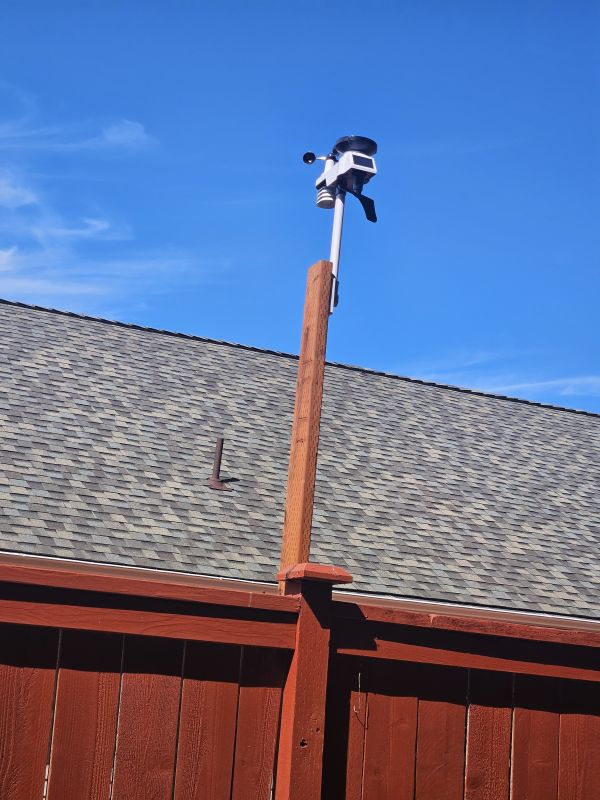
This past Thursday afternoon, Shelley and I were walking along the Lake Young’s Trail, which passes scores of backyard fences, when we came across this impressive little weather station I’d never noticed before.

What with the march of technology, there are a couple of items on this unit which I don’t recognize, but I do spot a wind-speed indicator (the little ice-cream-scoop thing, which probably has two other scoops out of sight behind the device), and a wind-direction vane poking out to the lower right. There’s probably also a thermometer, and maybe even a humidity-reader. And that black circular thing on top may be a rain gauge.

And do you see the black square on the front? It’s facing squarely south, and is probably the little solar panel which powers the station so that all its data can be sent by wifi or Bluetooth or something over to the house.

Bottom line: within that house lives someone who wants to keep track of outdoor conditions, what’s happening out beyond the dwelling’s walls. Temp dropping? Might need a jacket. Raining? Grab a wide-brimmed hat.

This homeowner has decided to not just depend on the radio or TV or Google to ascertain the weather. He or she wants right-now, right-here on-the-ground input.

That external-consciousness reminds me of how we need to resist the temptation to ignore all the distractions going on in our world – because Jesus insisted that we keep an eye on the “signs of the times” – and remember from Whom we receive the power to respond.

Want a review of what these signs will be? Click the link just below:

https://www.bibleinfo.com/en/topics/signs-jesus-coming

Listening

Photo and Commentary ©2026 by Russell Jurgensen
Thursday, July 30, 2026

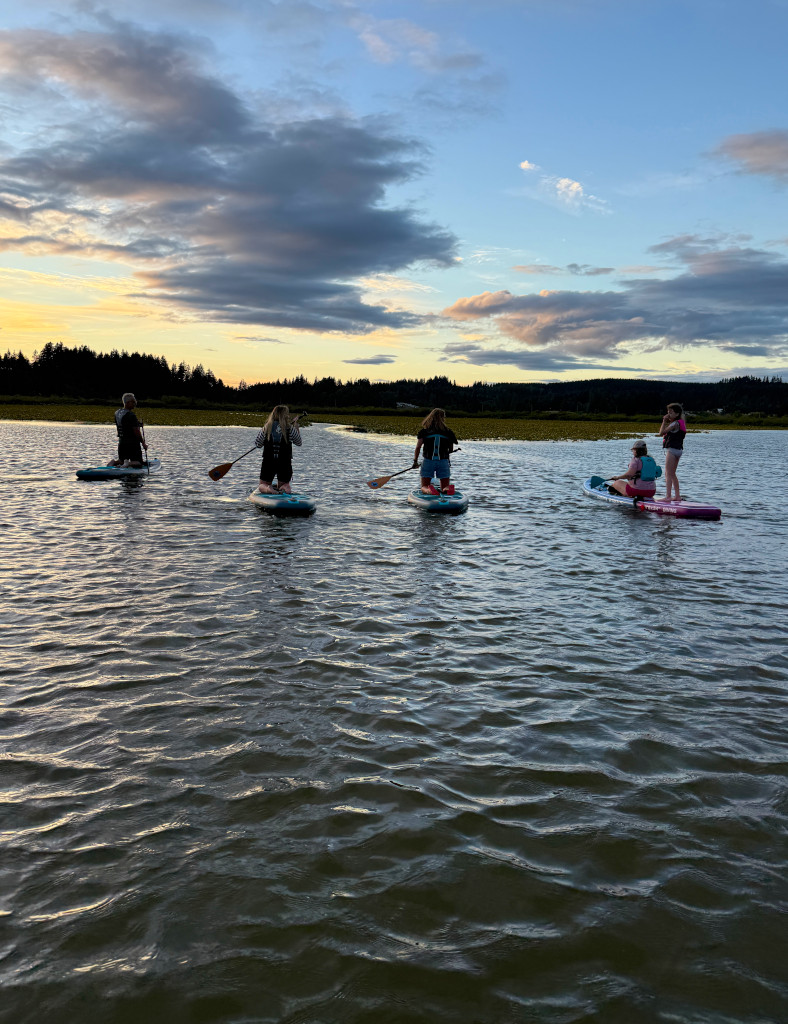
On this day at the lake, the weather was variable between brisk wind and rain. Then toward sunset the clouds broke and the wind slowed. Someone suggested it was a good time to get out on the water, and the group listened and acted. As a result, they enjoyed a few minutes of paddling out in nature.

Listen, my son, to your father’s instruction
and do not forsake your mother’s teaching.
Proverbs 1:8

When thinking about listening, some things come to mind. We learn by listening. We can make friends by listening to others. We can calm people and solve problems through active listening, where we acknowledge and ask follow-up questions.

An interesting concept is how we can spread the good news about Jesus by listening to people. We might be quick to tell people about our strong beliefs, but what a lot of people need is for someone to understand them. When they learn that we care enough to listen, they start to understand that Jesus really cares for them too.

Just like we watched the weather to find a good time to go on the lake, we can listen to know when and how to share God’s love.

Inside and Out

Photo and Commentary ©2026 by Darren Milam
Wednesday, July 29, 2026

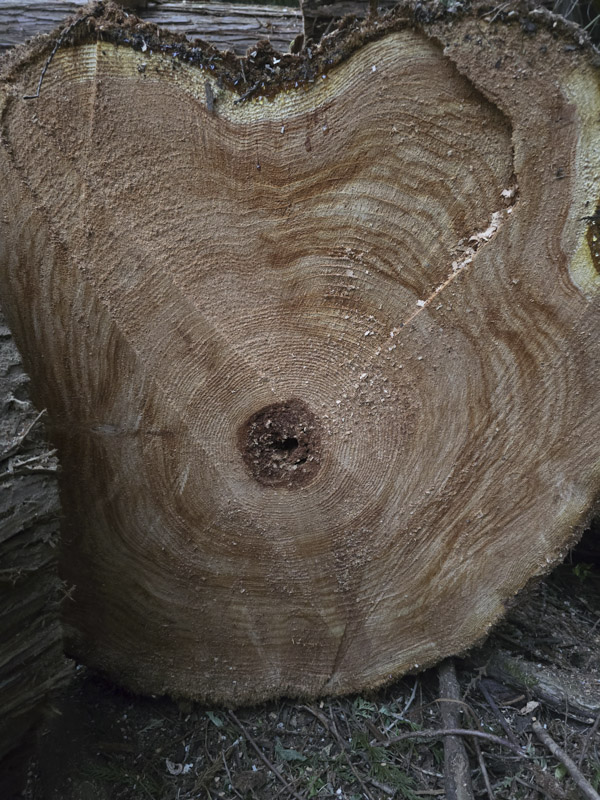
We recently had to have a few trees cut down on our property. This particular tree stood in our front yard and, according to its rings, had been growing for more than 70 years. It was approximately 75 feet tall but had been topped several years ago because of its height and proximity to our house.

What we didn’t realize was what was happening inside.

From the outside, the tree appeared healthy. Its bark looked solid, its branches seemed strong, and there were no obvious signs of trouble. But once it was cut down, the inside told a very different story. Even though the dark core looks tiny, I was able to push my fist into it with little resistence. The leader of the tree-cutting crew said, “Good thing you took this one down. It’s rotten.”

One of the greatest blessings we have is God’s promise to work in us from the inside out. David understood this and prayed in Psalm 51:10:

“Create in me a clean heart, O God; and renew a right spirit within me.”

When I saw the core of this tree, I was surprised by how unhealthy it was compared to what I had seen from the outside. Everything visible suggested a healthy tree, yet inwardly it was decaying.

People can be the same way. Outwardly, everything may appear fine, while inwardly there are struggles, wounds, fears, or sins that need attention. David recognized his need for change and asked God to do what only He could do – create a clean heart and renew a right spirit within him.

The encouraging truth is that God not only has the power to transform us inwardly, but He also invites us to ask Him. He is far more concerned with the condition of our hearts than our outward appearance.

My prayer, and perhaps yours as well, is simple:

God, please clean me inside and out. Create in me a clean heart and renew a right spirit within me. Amen.

Red Wattlebird   

Photo and Commentary ©2026 by Robert Howson
Tuesday, July 28, 2026

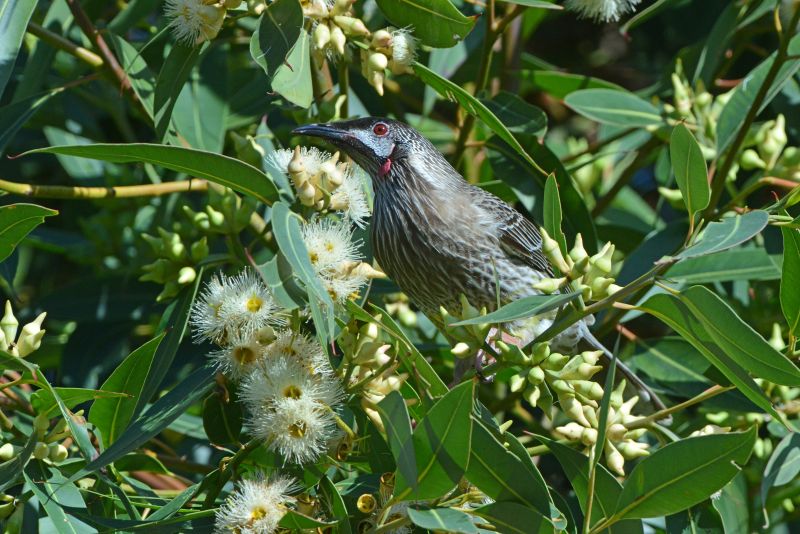
If you’ve ever played a game of Bible Trivia, here’s a question I’m guessing you’ve never heard asked.  And the reason is, the answer doesn’t come from the Bible, but from science.  What species of bird is known to have eaten manna?  Immediately your thoughts go back to the stories of the Children of Israel and their forty years of wandering in the wilderness.  But the answer doesn’t come from that story at all.  Instead, science tells us that the adult Red Wattlebird feed their young manna, a name given to nutritious crystallized plant sap.  This, along with insects, makes up their diet at the early stages of life.

In contrast, adult Red Wattlebirds are among the largest nectarivorous birds, using their brush-tipped tongues to extract nectar from a variety of flowering plants.  They are aided in doing so by a long tongue which contains around 120 bristles.  These bristles increase the surface area of the tongue and soak up the nectar through capillary action.

Interestingly, this ability wasn’t unique enough to be included in the bird’s name.  Instead, early taxonomists seem fixated on the fleshy protrusion on the neck.  We’re accustomed to seeing wattles on larger birds, like turkeys, but they seem oddly out of place on one who spends its life flitting from flower to flower.

Names seem not to carry the same significance they did in the long-ago-biblical past, but if you’ve ever been given a nickname, you can probably more easily relate to its connotation.  For these personal names often reflect a quality or characteristic of the individual.  We might not like our nickname for it may call attention to an attribute we don’t want others to especially notice.  On the other hand, some of these names reflect a personal warmness, a closeness shared between just the two of you.

You’ve undoubtedly read about receiving a new name when Christ returns to take us home.  But Revelation 3:12 adds a new twist that perhaps you’ve never thought of before, because it speaks of Christ also receiving a new name:  “I will write on them the name of my God and the name of the city of my God, the new Jerusalem, which is coming down out of heaven from my God; and I will also write on them my new name.” (NIV)  Why would God need a new name?  I don’t know the answer, but I’d like to think it has something to do with that closeness we talked about earlier, an intimacy between Christ and the one He has saved.

Frayed

Photo and Commentary ©2026 by Shelley Schurch
Sunday and Monday, July 26 and 27, 2026

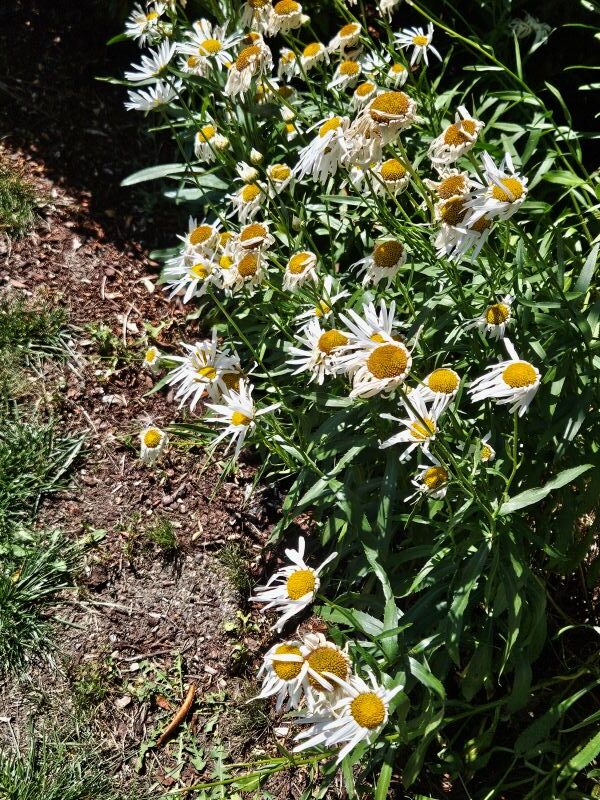
An odd phrase popped into my mind when I saw these daisies; I thought they looked like “frayed flowers.” Not wilted or drooping – frayed.

That’s a word I usually associate with things non-floral, like cords, fabric, and nerves. The latter reminds me of the “you better watch out” declaration: “I have one last nerve and you’re standing on it!”

Dictionary definitions of “frayed” include: “strained by constant stress,” “worn down by strain or irritation,” and “showing the effects of pressure or strain.”

A personal, recent example: I was fine with last Tuesday’s 92° heat, but by Wednesday afternoon the same high heat felt relentless, and I felt frayed (because I felt fried!). I think the daisies in my photo have felt the heat, too.

As is my wont, I thought about people I’ve met in the pages of my Bible. Who came to mind first as someone who seemed frayed? After I pondered, I asked my husband and was astounded that we’d thought of the same person – astounded because he isn’t one of the “big names” in the Bible.

We both thought of Obadiah. Read I Kings 18:1-15 and you’ll see why he came to mind as someone under strain and stress!

The next person I thought of is a “big name” in the Bible. A really big name: Moses. Reading through the book of Exodus, we marvel at the challenges he faced, leading thousands of newly-freed slaves out of captivity, into the desert, on the journey to their Promised Land.

These people were not sitting down in their tents every night, writing three things they were thankful for. They tended to whine and grumble and complain and blame their leader, and his God, for any perceived lack in their liberated lives. All the time they were eating food that faithfully fell from heaven. A pillar of cloud by day and fire by night showed that the Lord continued to travel with them, and guide as well as provide for them.

Yet they grumbled and accused and rebelled and eventually constructed a golden calf to worship. That definitely struck a nerve — God’s nerve:

Then the Lord said to Moses, “Go down, because your people, whom you brought up out of Egypt, have become corrupt. They have been quick to turn away from what I commanded them and have made themselves an idol cast in the shape of a calf. They have bowed down to it and sacrificed to it and have said, ‘These are your gods, Israel, who brought you up out of Egypt.’

“I have seen these people,” the Lord said to Moses, “and they are a stiff-necked people. Now leave me alone so that my anger may burn against them and that I may destroy them. Then I will make you into a great nation.” (Exodus 32:7-10 NIV)

Moses could have said, “Thank you, Lord. I understand your anger. I agree with your new plan.” But he does not leave Him alone. He begs the Lord to relent, giving Him excellent reasons for doing so. And the Lord relents.

But Moses descends from the mountain and finds the situation much worse than he could have imagined. Now his anger burns. A terrible time of reckoning ensues, but then, this incredible scene:

So Moses went back to the Lord and said, “Oh, what a great sin these people have committed! They have made themselves gods of gold.  But now, please forgive their sin—but if not, then blot me out of the book you have written.” (Exodus 32:31-32)

I am in awe of Moses’ response and request. Instead of asking the Lord to give him an easier life than leading these stiff-necked, rebellious people, he is willing to intercede for them to the point of giving up his place in God’s kingdom, giving up his life.

Moses wasn’t perfect, but in this scene we recognize his likeness to the One who is.

When things become too much for us, when we feel the stress and strain of life on this perilous planet, perhaps we might want to sit down and write three things we’re thankful for, a trio of blessings.

That reminds me of the Three we’re most thankful for, the Trinity of God the Father, Jesus Our Saviour, and Holy Spirit Guide and Comforter. Whenever we’re frayed, or afraid, we can remember that we are not alone, but known and held and loved with an everlasting love.

Blog Archives

Rivoli’s Hummingbird        

Photo and Commentary ©2026 by Robert Howson Tuesday, August 4, 2026 Our previous exposure or experience may cause us to make generalizations that may not necessarily be warranted.  We can use Rivoli’s Hummingbird, a species found in the Southwest, to illustrate this....

Sky

Photo and Commentary ©2026 by Shelley Schurch Sunday and Monday, August 2 and 3, 2026 I don’t think I’m much of a desert person. (Although, I am definitely a dessert person, if you’re serving up homemade apple pie!) Heat, with or without humidity, makes me a...

Weather Station

Photo and Commentary ©2026 by Maylan Schurch Friday and Sabbath, July 31 and August 1, 2026 This past Thursday afternoon, Shelley and I were walking along the Lake Young’s Trail, which passes scores of backyard fences, when we came across this impressive little...

Listening

Photo and Commentary ©2026 by Russell Jurgensen Thursday, July 30, 2026 On this day at the lake, the weather was variable between brisk wind and rain. Then toward sunset the clouds broke and the wind slowed. Someone suggested it was a good time to get out on the...

Inside and Out

Photo and Commentary ©2026 by Darren Milam Wednesday, July 29, 2026 We recently had to have a few trees cut down on our property. This particular tree stood in our front yard and, according to its rings, had been growing for more than 70 years. It was approximately 75...

Red Wattlebird   

Photo and Commentary ©2026 by Robert Howson Tuesday, July 28, 2026 If you’ve ever played a game of Bible Trivia, here’s a question I’m guessing you’ve never heard asked.  And the reason is, the answer doesn’t come from the Bible, but from science.  What species of...

Frayed

Photo and Commentary ©2026 by Shelley Schurch Sunday and Monday, July 26 and 27, 2026 An odd phrase popped into my mind when I saw these daisies; I thought they looked like “frayed flowers.” Not wilted or drooping – frayed. That’s a word I usually associate with...

Revision

Photo and Commentary ©2026 by Maylan Schurch Sabbath, July 25, 2026 A few days ago, in quest of a wedding gift, Shelley and I traveled to a nearby town. One of our destinations was a delightful used-book store. My photo is taken from the store’s second level, which...

This Little (?) Light of Mine

Photo and Commentary ©2026 by Maylan Schurch Friday, July 24, 2026 About a half-hour before sunset this past Sunday, I opened our front door, and was about to step out onto the porch when this blaze of sunshine hit my eye. The photo doesn’t do justice to its blinding...

Bee Silent

Photo and Commentary ©2026 by Darren Milam Wednesday and Thursday, July 22 and 23, 2026 Many of the flowers in our garden are in full bloom right now, including this cosmos plant, which is enjoying its second round of blossoms this season. As you can see, it has...