Photo and Commentary ©2026 by Robert Howson
Tuesday and Wednesday, August 4 and 5, 2026
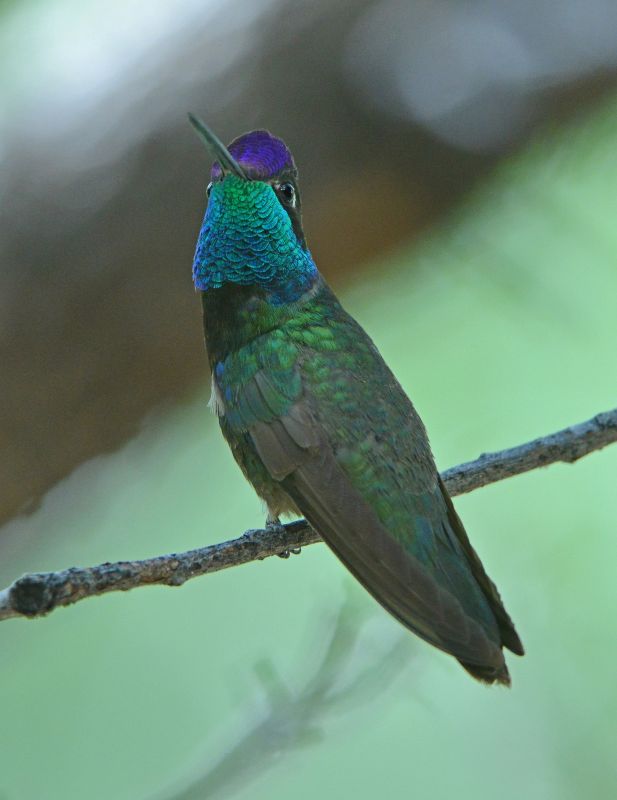
Our previous exposure or experience may cause us to make generalizations that may not necessarily be warranted. We can use Rivoli’s Hummingbird, a species found in the Southwest, to illustrate this. Many of us have been dazzled by the flash of brilliant red on the throat of a hummingbird as the light seemingly set the bird on fire. From this we might have concluded all hummingbirds share this same quality, but a look at Rivoli’s makes us realize red isn’t the only option available. We’re amazed with their long, sometimes decurved bill which allows it to obtain nectar from flowers and assume others should be equally impressed. While they may have been, the taxonomists elected to focus on another feature and placed them in the order Apodiformes, along with swifts, which simply means small feet.
And all hummingbirds are tiny, right? Well, not really. The largest is the Giant Hummigbird found in South America which is about the size of a Northern Cardinal. The Rivoli’s is considerably smaller, but still the second largest of the 14 species known to breed in the United States. With its larger size comes slower wingbeats, almost slow enough for the human eye to see. Sometimes it will even extend those wings and glide. Furthermore, not all hummingbirds are called hummingbirds, in fact only a little more than one fourth of the group is known by this name. Consider the image created by these alternative names: sabrewing, woodnymph, sapphire, coquette, fairy, mountain-gem, sunbeam, and the list goes on and on.
From these names, as well as from our own experience, it would be safe to assume this family of some 320 species is full of surprises. Remember, while our assumptions may at times be helpful, they may not always be right. In Christ’s parable of the workers who were hired at different times throughout the day, the workers who began work earlier wrongly assumed they would be paid more than those who worked just a short time. (Matthew 20:10) But Paul gives us an example where logic leads us to a proper assumption. “The potter, for instance, is always assumed to have complete control over the clay, making with one part of the lump a lovely vase, and with another a pipe for sewage. Can we not assume that God has the same control over human clay?” (Romans 9:21-22 J.B. Phillips New Testament)