Photo and Commentary ©2026 by Shelley Schurch
Sunday and Monday, August 9 and 10, 2026
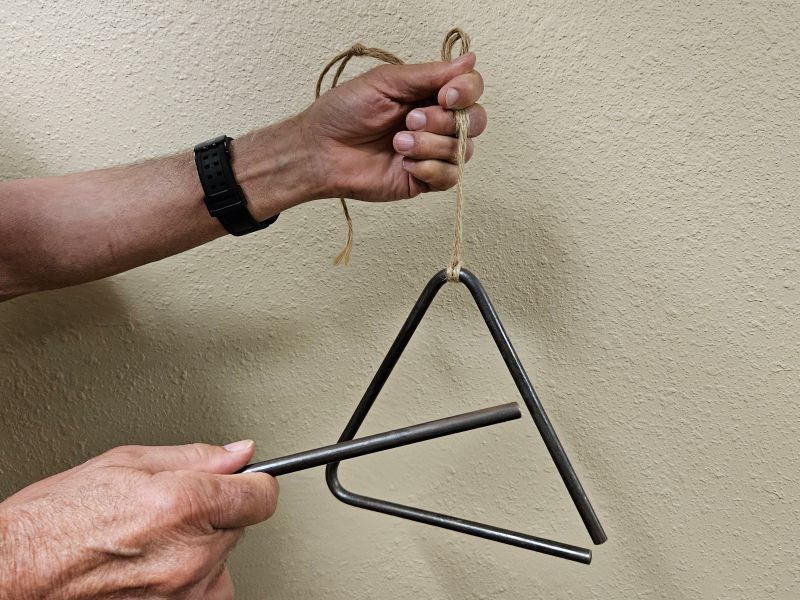
What I really wanted to play was the drum, but I was assigned to the triangle. Mrs. Nelson, my second-grade teacher, had organized us into a band. Looking back on it now, I realize that might not have been an easy task.
We were a large class, with limited musical background, but she bravely signed us up for a performance of two songs at a Parent-Teacher Association meeting. I remember only a few things from second grade, but standing on stage as a member of this band is one of them.
We were lined up in a long semicircle for the first song, then Mrs. Nelson played a lively rendition of “Alexander’s Ragtime Band” while everyone filed to the back of the stage, deposited their instruments in a big box, each picked up a different instrument, and filed back to their original positions.
Everyone but me. I had been instructed to stay in place, holding my triangle, while everyone else exchanged instruments.
I remember staring out into the audience and feeling embarrassed as I waited for my classmates to come back to the line. I thought that the teacher must have decided I could only be trusted to play the triangle, that I was not good enough to play a second instrument like everyone else. And everyone could see that.
When I shared this story with one of my friends a few years ago, she smiled and said, “Wait a minute – what if the reason you had to hang on to that triangle was that your teacher thought you played it so well that she needed you to play it for both songs!”
Well . . . I was dubious. But I had to smile back, because I liked her reframing! She chose to view my situation from a much more positive perspective than the story of shame I’d been telling myself for years.
I’ve been paying attention to reframing lately, appreciating when other people do it, and trying my hand at it, too. I think that’s why I’ve noticed instances of reframing in the Bible, including these:
The Israelite soldiers were terrified of Goliath, the Philistine giant who taunted and challenged them for forty days, morning and night. Young David comes to the Israelite camp to bring food to his older brothers, hears and sees the giant, and says, “Who is this uncircumcised Philistine that he should defy the armies of the living God?” (1 Samuel 17:26 NIV)
He tells King Saul that, despite his youth, he will fight the giant, and proclaims to the Philistine:
You come against me with sword and spear and javelin, but I come against you in the name of the Lord Almighty, the God of the armies of Israel, whom you have defied. This day the Lord will deliver you into my hands, and I’ll strike you down and cut off your head. This very day I will give the carcasses of the Philistine army to the birds and the wild animals, and the whole world will know that there is a God in Israel. All those gathered here will know that it is not by sword or spear that the Lord saves; for the battle is the Lord’s, and he will give all of you into our hands. (1 Samuel 17:45 – 47)
And He did. Where the Israelite soldiers only saw a menacing giant and sure defeat, David reframed the situation to a big bully defying his God, who would most assuredly win the battle for them.
And then my mind leaped to Joseph, and my favorite part of his roller coaster life of bad news, good news, bad news, good news, etc.:
When Joseph’s brothers saw that their father was dead, they said, “What if Joseph holds a grudge against us and pays us back for all the wrongs we did to him?” So they sent word to Joseph, saying, “Your father left these instructions before he died: ‘This is what you are to say to Joseph: I ask you to forgive your brothers the sins and the wrongs they committed in treating you so badly.’ Now please forgive the sins of the servants of the God of your father.” When their message came to him, Joseph wept.
His brothers then came and threw themselves down before him. “We are your slaves,” they said.
But Joseph said to them, “Don’t be afraid. Am I in the place of God? You intended to harm me, but God intended it for good to accomplish what is now being done, the saving of many lives. So then, don’t be afraid. I will provide for you and your children.” And he reassured them and spoke kindly to them. (Genesis 50:15-21)
Joseph was clear-eyed in remembering “all the wrongs” his brothers did to him, but he reframed his situation. He saw their intentions, but he saw that God’s intentions overruled and saved people from starvation. He couldn’t hold a grudge when he saw things from God’s perspective.
Once I start looking, the reframings are everywhere. The angel tells Joseph that what looks bad is really good, eternally good. Marry Mary, and her Son will be your Saviour.
The apostle Paul is imprisoned and shackled, but reframes his situation to being “in chains for Christ,” as a witness to the whole palace guard and an encouragement to fellow believers to proclaim the gospel without fear.
And then the ultimate reframing. It was an old rugged cross, a common instrument of torture and death for criminals. When Jesus, nailed to that cross, cried out, “It is finished!” it was a cry of victory. He had carried out the mission, He had paid the price for our sins, at the risk of eternal death. The cross has been reframed as a symbol of sacrifice, salvation, and love.