Photo and Commentary ©2026 by Robert Howson
Tuesday, July 28, 2026
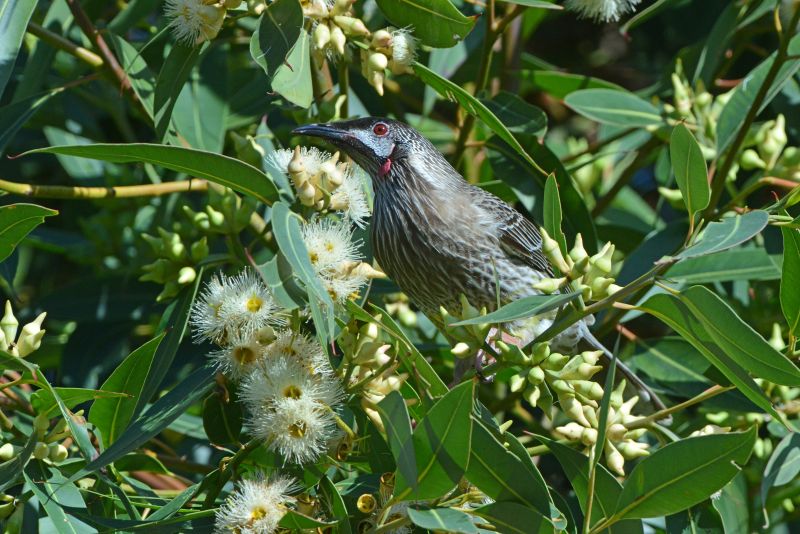
If you’ve ever played a game of Bible Trivia, here’s a question I’m guessing you’ve never heard asked. And the reason is, the answer doesn’t come from the Bible, but from science. What species of bird is known to have eaten manna? Immediately your thoughts go back to the stories of the Children of Israel and their forty years of wandering in the wilderness. But the answer doesn’t come from that story at all. Instead, science tells us that the adult Red Wattlebird feed their young manna, a name given to nutritious crystallized plant sap. This, along with insects, makes up their diet at the early stages of life.
In contrast, adult Red Wattlebirds are among the largest nectarivorous birds, using their brush-tipped tongues to extract nectar from a variety of flowering plants. They are aided in doing so by a long tongue which contains around 120 bristles. These bristles increase the surface area of the tongue and soak up the nectar through capillary action.
Interestingly, this ability wasn’t unique enough to be included in the bird’s name. Instead, early taxonomists seem fixated on the fleshy protrusion on the neck. We’re accustomed to seeing wattles on larger birds, like turkeys, but they seem oddly out of place on one who spends its life flitting from flower to flower.
Names seem not to carry the same significance they did in the long-ago-biblical past, but if you’ve ever been given a nickname, you can probably more easily relate to its connotation. For these personal names often reflect a quality or characteristic of the individual. We might not like our nickname for it may call attention to an attribute we don’t want others to especially notice. On the other hand, some of these names reflect a personal warmness, a closeness shared between just the two of you.
You’ve undoubtedly read about receiving a new name when Christ returns to take us home. But Revelation 3:12 adds a new twist that perhaps you’ve never thought of before, because it speaks of Christ also receiving a new name: “I will write on them the name of my God and the name of the city of my God, the new Jerusalem, which is coming down out of heaven from my God; and I will also write on them my new name.” (NIV) Why would God need a new name? I don’t know the answer, but I’d like to think it has something to do with that closeness we talked about earlier, an intimacy between Christ and the one He has saved.