
Photo and Commentary (c)2025 by Robert Howson
Tuesday, September 2, 2025
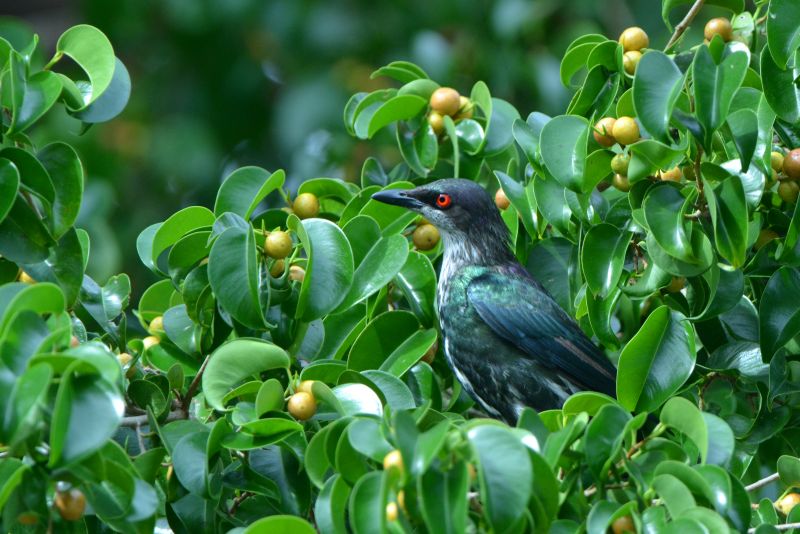
Unlike the invasive Eurasian Starling, which has taken over much of North America, the Metallic Starling is native to Papua New Guinea and its travels are limited to the 100 or so miles to nest in the northernmost parts of Queensland, Australia. Also, unlike their cavity nesting relatives, the Metallic Starling builds a suspended globular nest in the tall trees of the rain forest during the wet season. The adult appears black from a distance but in the right light their feathers reflect purple and green making it deserving of the metallic name. Juveniles, like the one shown here, have a white patch on the chest which extends up toward the throat.
What’s so amazing about this bird is a discovery made by a 14-year-old boy who lived in this challenging setting. One night Daniel Natusch stumbled upon a clearing beneath a poison-dart tree where hundreds of Metallic Starlings had built their globe-shaped nests. The ground beneath these nests was as barren as a moonscape due to the guano deposited. The nutrient level was high enough to kill off most of the vegetation under the nests. In this barren microcosm he found half a dozen snakes assembled, patiently waiting for eggs or baby birds to fall to the ground where they would be consumed. This, along with food dropped by the birds, invited other consumers to the feast.
He returned as a graduate student to observe this short-lived ecosystem, and discovered in two monsoon seasons that more than 100,000 animals of 42 species feasted beneath 27 trees during the four month breeding season of the starlings. All of this due to the relationship between the birds and the snakes.
Notice Solomon’s commentary on discovery: “…then I saw all that God has done. No one can comprehend what goes on under the sun. Despite all their efforts to search it out, no one can discover its meaning. Even if the wise claim they know, they cannot really comprehend it.” (Ecclesiastes 8:17 NIV) This in no way should be used to discourage exploration and pursuit of understanding. Instead, recognize there will always be more to uncover, more questions to be answered. This should keep us humble indeed.