
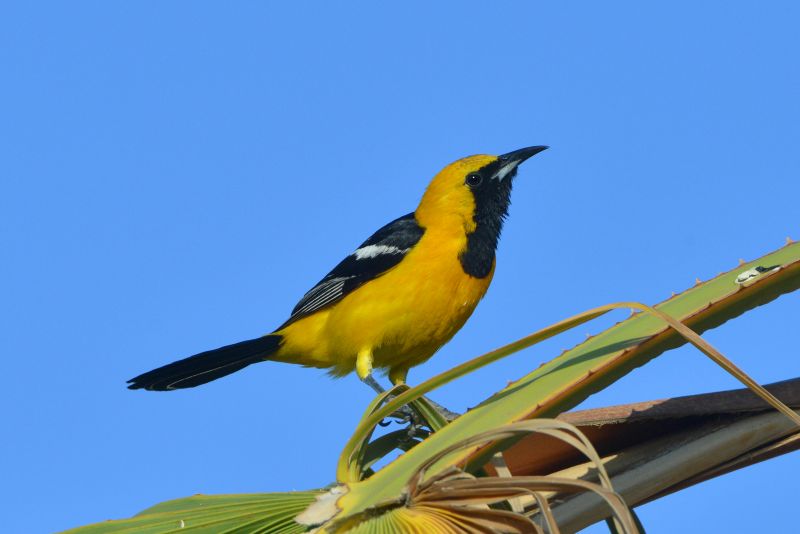
Photo and Commentary ©2026 by Robert Howson
Tuesday and Wednesday, September 15 and 16, 2026
As the early Christian church grew in the first century it came in contact with a wide diversity of people not generally encountered in Judea. This presented new challenges on how to deal with issues which had not previously arisen and Paul spent much of his time addressing how to deal with this diversity. Obviously, it’s still a challenge we haven’t completely resolved.
Nature is replete with variety, and this extends even into the oriole family. When we think of the nests of orioles, the long, hanging pouch comes to mind. And this is also true of the Hooded Oriole’s nest, but it includes more specific demands upon the setting for its home. This oriole can be found across the southern part of states reaching from California to Texas. As more ornamental plants have been introduced and more hummingbird feeders erected, the bird’s range has extended northward along the coast. It seems to be especially fond of palms in which to build its nest. When the female constructs the nest in these leaves she pokes holes in them; then working from the underside, she pushes fiber through, sewing the nest together. This takes her three to four days to complete. No one really knows why they prefer palms, but they do. It’s just part of what makes them unique.
This distinctiveness may actually work to benefit the species. And in the same way, those unique qualities which we bring to the body of Christ may be used to enrich the church. Paul never suggests unity is to be brought about by conformity. Instead, he offers an approach that fits all, in all situations: “Always be humble and gentle. Patiently put up with each other and love each other. Try your best to let God’s Spirit keep your hearts united. Do this by living at peace.” (Ephesians 4:2-3 CEV)