Photo and Commentary ©2025 by Maylan Schurch
Sabbath, September 13, 2025
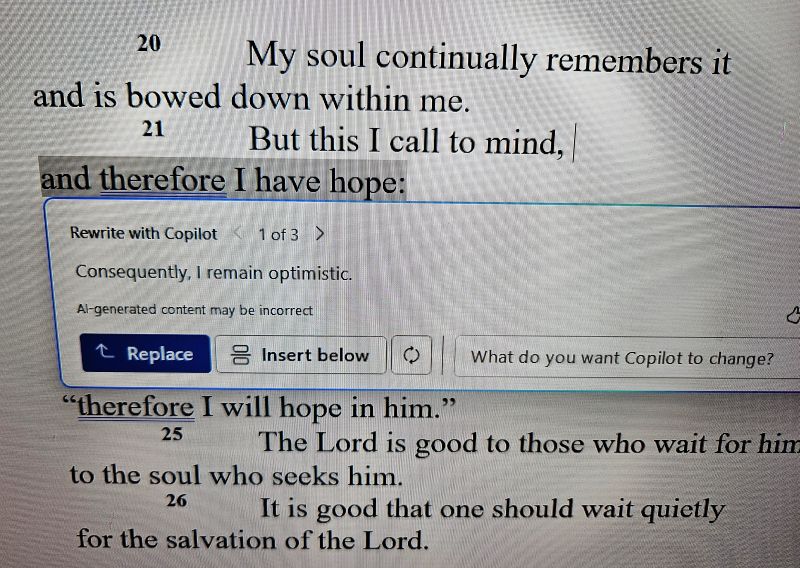
Halfway through last week, as I was studying Lamentations 3 to prepare for a sermon, I had the passage up on my laptop screen. Suddenly (as you see in the photo above), my mouse highlighted the clause “and therefore I have hope.”
I’ve notice in recent months that artificial intelligence (AI) has been getting more assertive. No longer, if you need it, do you have to go and get it. Nowadays it trails you around like a puppy or a two-year-old, trying to get your attention, begging you to let it help you.
As soon as the mouse had highlighted “and therefore I have hope,” the AI box popped up. I discovered that it was offering me a paraphrase: “Consequently, I remain optimistic.”
Good try, A-I! (This is spoken sarcastically.) As someone who for decades has been perfectly capable of choosing and arranging my own words, this annoyed me. And the words I’d highlighted actually aren’t mine – they’re Bible words. And even though “consequently, I remain optimistic” is indeed an approximate paraphrase, I prefer the original.
Why? For one thing, “Therefore I have hope” has just five syllables, while the machine-generated paraphrase has eleven. The original has words of one syllable, except for “therefore,” while the paraphrase has two words (the first and the last) which each have four syllables. “Consequently, I remain optimistic” sounds like what a company CEO might write in the introduction to the annual report.
Anyway, that’s my rant for today. But I guess the sober truth behind it is that we need to take the Bible as it reads. Sure, there’s a whole spectrum of translations out there, and all have some good qualities. But there are ways you and I can stay as close to the original as possible.
One way is to read from three or four literal translations. The ones I use are the New King James, the New International Version, the English Standard Version, and the New Revised Standard Version. These four will give you solid translations. Read them all, and you’ll gradually get the “feel” for what’s happening in the original Hebrew or Greek. Then you can check out other, looser translations, but you’ll always want to verify them against the NKJV, the NIV, the ESV and the NRSV.
To read or review just what the Bible has to say about its own important, check out the following link. Once you’re there, keep scrolling down for lots of fascinating Scripture facts.