Daily Photo Parable

Welcome Surprise

Photo and Commentary ©2026 by Darren Milam
Wednesday, February 25, 2026

This past week, we were “lucky” enough to have a bit of snowfall that covered the trees, ground and rooftops for the better part of 3 days. The accumulation didn’t interfere with our daily activities but did provide a beautiful backdrop to our local area.

As you can see from the image, the trees were backlit from the gorgeous sun-filled blue sky. The scene gives a chilly feel, with the dark contrasts of the evergreen boughs, the stark blue sky and the white flakes clinging to the branches.

God is the creator of such a scene. It’s not painted or printed and hung on a wall. No, the canvas God uses is His very creations – air, sky, trees, light. A masterful example of the beauty He creates for our eyes to take in. What a welcome surprise, and sight to behold.

Life is filled with similar welcome surprises. This past week, in our Sabbath School class, we were studying the Trinity and specifically, the Holy Spirit. When it comes to the trinity, specifically the Holy Spirit is known as the Helper, the Comforter, Counselor, and Advocate. Of all those defined characteristics and titles, do we associate them with being negative? No, they are all positive definitions.

God is with us always. The Holy Spirit was sent to us to ensure we were close. We know for a fact we don’t always visually see God, but we can see His presence. We can see the beauty He creates and shares. We see His works in our lives. We feel His presence, as we look to be comforted. We hear His voice, as we ask for counsel. God can surprise us each and every day. I, for one, will welcome those surprises. Will you do the same?

Bananaquit 

Photo and Commentary ©2026 by Robert Howson
Tuesday, February 24, 2026

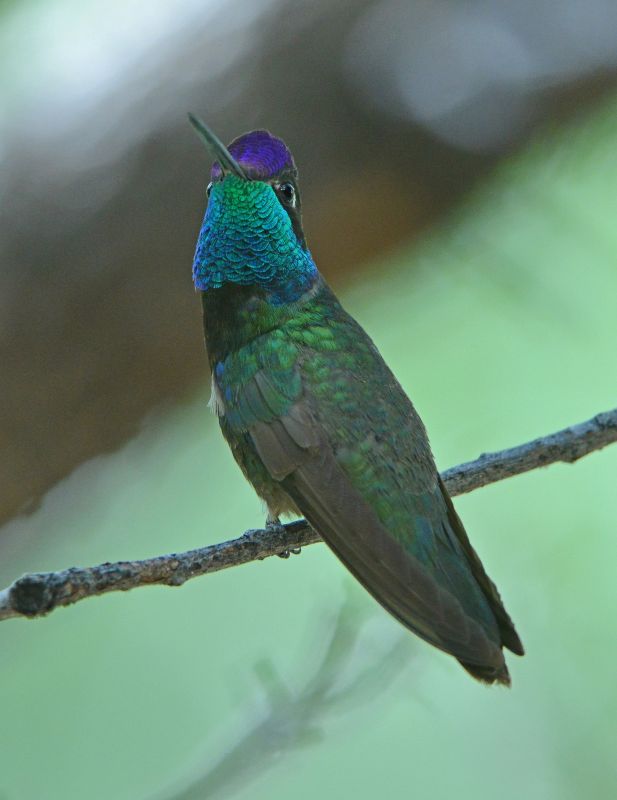
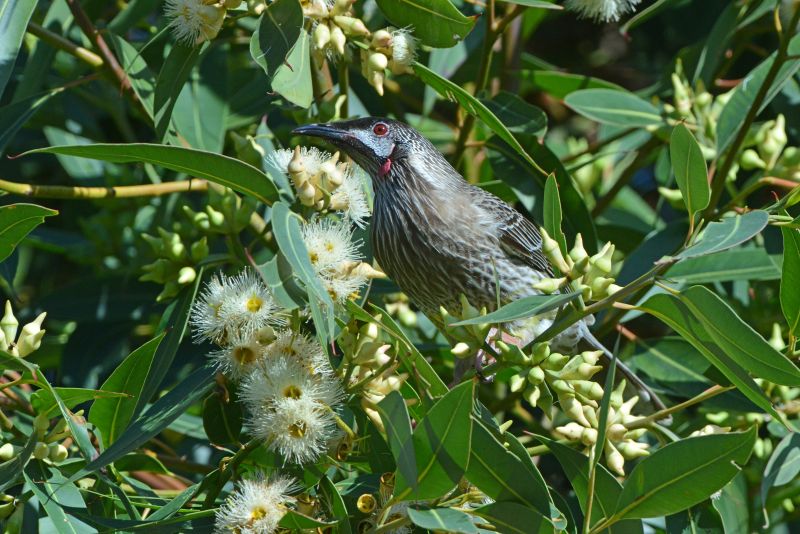
If you’ve ever taken a psychological test to determine your personality type, you may have come away feeling like a Bananaquit.  Yes, you were friendly, outgoing, adaptable to new situations, and maybe even attractive, but you also seemed to fit into many of the other categories as well.  It was just hard to know where you really fit.  That’s where you might best identify with this Latin American bird.  Before we had the tools offered by 21st century molecular genetics, this species was variously classified as a sparrow, or alternatively, grouped with the warblers.  Now it is recognized as a specialized tanager.  And within that species, 41 subspecies are recognized!

Fortunately for the Bananaquit, it doesn’t have to worry about classification and can continue enjoying life in the tropics.  It does have a specialized lifestyle, dangling upside down from flowers while searching for nectar or gleaning insects and spiders from the foliage.  It will also come to hummingbird feeders to feed on the sugar-water offered there.  Because it may become quite tame after repeated contact with humans, it has become a favorite with many and has been named the official bird of the U.S. Virgin Islands.

Unlike this friendly bird, we humans are prone to compare ourselves with those around us to see how we measure up.  While there may be times when that is appropriate, it doesn’t have any place in assessing our spiritual growth according to the Apostle Paul: “We do not dare to classify or compare ourselves with some who commend themselves.  When they measure themselves by themselves and compare themselves with themselves, they are not wise.” (2 Corinthians 10:12 NIV)  And one last thing; there’s one other way we are like the Bananaquits; the collective term for a group of these birds is a “bunch”.  How appropriate!

God’s Voice

Photo ©2010 and Commentary ©2026 by Chuck Davis
Monday, February 23, 2026

The Yaquina Head Lighthouse near Newport, Oregon remains an active, fully automated aid to ships navigating the Pacific Ocean along the Oregon coast. It flashes a unique pattern: 2s on, 2s off, 2s on, 14s off. Navigators can use this pattern to confirm their location.

The unique pattern of the lighthouse is its voice, and people can know when it is speaking. In the same way, we can know His voice when God speaks to us:

John 10:27: “My sheep hear my voice, and I know them, and they follow me”.

  • 2 Timothy 3:16-17: “All Scripture is God-breathed and is useful for teaching, rebuking, correcting and training in righteousness”.
  • Hebrews 4:12: “For the word of God is living and active, sharper than any two-edged sword…”.
  • Isaiah 30:21: “…your ears will hear a voice behind you, saying, “This is the way; walk in it.”

The more intently we listen for God’s voice, the more readily we will recognize it. The Lighthouse uses a unique pattern to ensure it is not mistaken for another voice. You can be sure that it is not God’s voice if it conflicts with what He has written in His Word.

Framework

Photo and Commentary ©2026 by Maylan Schurch
Sabbath and Sunday, February 21 and 22, 2026

Almost exactly a month ago, on our post-breakfast walk, I noticed this almost unearthly object. I’ve seen dried leaves with this intricate lacy pattern, but this almost seemed round. Whatever it is, its framework takes my breath away.

The blue fur at the right is the right-hand glove of my wife Shelley, who obligingly held this plant while I snapped its photo. Shelley’s hand, within the glove, has its own framework, which she uses in many-talented ways, writing notes, preparing food, texting someone on her phone.

I wonder how many breathtaking experience you and I would have if we paused to consider the frameworks of what we see. The apples, grapes, and tangerines Shelley serves me for breakfast lie beautifully on my plate. The trees on our walk form perfect frames for juncos, Stellar jays and hummingbirds. And the structural miracles of these instinctive flyers, to me, are proofs of God’s creatorship.

I think it’s a good idea to remind ourselves that, in spite of the tragedy of sin, we were superbly created by a God of utter love. Check out the link just below:

https://www.bibleinfo.com/en/topics/creation-and-evolution

Deterrent?

Photo and Commentary ©2026 by Maylan Schurch
Friday, February 20, 2026

Take a few seconds to gaze on the mournful photo above. This year, a distressing number of my neighborhood’s lawns are starting to look like this – and some much worse. According to homeowners’ grim comments I’ve heard, this devastation is being caused by raccoons, who during the night systematically rip up these lawns in search of grubs. In the daytime, crows work the second shift, pecking for the grubs the raccoons missed. And the other day I even saw a sedate robin assessing the damage, wondering if anything was left for him.

Aside from sitting up all night on the porch with a cocked BB gun, there seems to be nothing a householder can do about this. Although the other day I saw that someone had tried the intimidation route:

I’m about to offer a suggestion, which is based squarely on no knowledge whatever of racoons, and only minimal knowledge of lawn care. I have no empirical evidence, and haven’t even Googled “How to keep racoons from tearing up a lawn”, still, I have been studying lawns on my daily walks, and have come up with the following.

I believe that the lawns which raccoons can successfully destroy are the ones (like my own, which for some reason has so far escaped the carnage) which have been neglected. These lawns are patchy, with bare areas and a bit of moss. But the lawns whose owners have regularly seeded and fertilized, have escaped. I have yet to see a healthy lawn, like the one in the photo below, which has been ravaged.

The reason, I think, is that well-planted and cared-for grass is awesomely tough. I would imagine that raccoons won’t even bother trying to tear up strips of this kind of sod, because it’s too much work. Those grass-roots are anchored too deep, too close together.

Okay. If my statements are factual at all, there must be a parable in there somewhere, right? How about this: A life which is kept spiritually healthy is less likely to fall victim to the Devil’s ravages.

And the Bible backs me up on this. Click the link below:

https://www.bibleinfo.com/en/topics/spiritual-growth

Camellia’s Temperature

Photo and Commentary ©2026 by Russell Jurgensen
Thursday, February 19, 2026

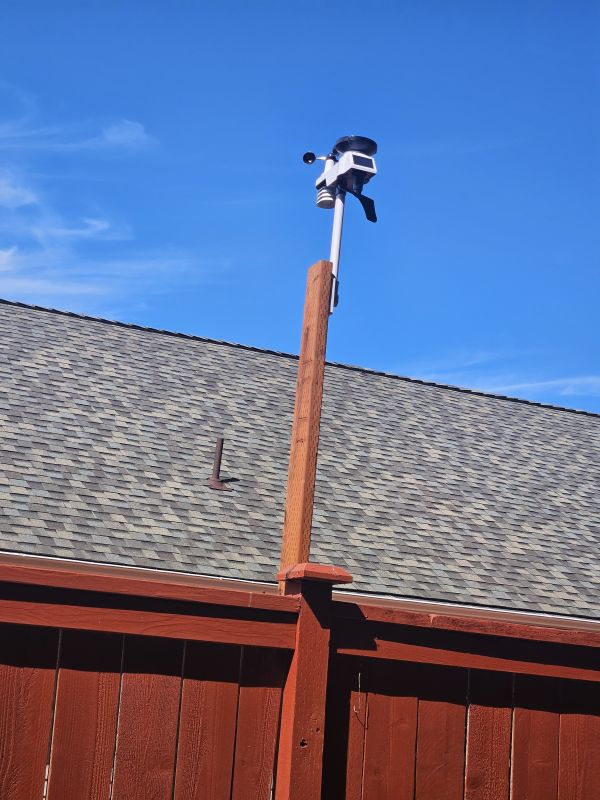
This outdoor temperature sensor happens to be right next to a Camellia bush. The bushes provide some protection against direct sunlight on the sensor. The louvered shape of the housing also protects the sensor from the elements.

It makes me think about protection in our spiritual lives. Having recently attended a memorial service for a friend, we might wonder what it means to receive God’s protection. We still have troubles in this world that result in sickness and death. I like the following verses.

For I am convinced that neither death nor life, neither angels nor demons, neither the present nor the future, nor any powers, neither height nor depth, nor anything else in all creation, will be able to separate us from the love of God that is in Christ Jesus our Lord.
Romans 8:38-39

This seems to cover a lot when it says neither death nor life can separate us from the love of God. When we have that assurance that nothing can separate us, we can gather that true sense of protection that Jesus promises.

Certainly, we still want and pray for protection from evil while we live on this Earth. We still want the best for our family and neighbors. But having the knowledge of God’s eternal love gives us freedom to keep our temperature high in reflecting God’s love to others.

Expected Arrival

Photo and Commentary ©2026 by Darren Milam
Wednesday, February 18, 2026

If you live in the Pacific Northwest, you’ve likely noticed how unusually warm the past few weeks have been. Even though winter officially began on December 21 and we are still very much in the heart of the cold season, the mild temperatures are already stirring signs of what’s to come. With this warmth, crocuses—like the one pictured—begin to emerge from their winter dormancy. Soon, their bright colors will start dotting open fields, parks, and flowerbeds.

For anyone familiar with gardening, or flowers in general, spring‑blooming crocuses (members of the iris family) are among the earliest bloomers of the year. They’re remarkably resilient, sometimes pushing up through snow if winter makes a brief return in late February or early March.

Of course, the timing of their arrival depends on location, climate, and the weather. Still, in general, you can count on these flowers to appear year after year. Their emergence is expected.

They remind me of something deeper—our faith, and the only expected arrival that truly matters: the return of Jesus. Do we know the exact day or hour He will return?

Matthew 24:42 answers that question for us, “Therefore keep watch, because you do not know on what day your Lord will come”

We don’t know the when or the where, yet we still believe in the arrival. We live with expectation—and that is a good thing.

John records the very words when Jesus addresses the promise.

John 13:3, “And if I go and prepare a place for you, I will come back and take you to be with me that you also may be where I am.

Now that is the true meaning of an “expected arrival.” Just as we can count on the spring‑blooming crocus to appear, we can also trust in the coming of our Heavenly Father. Amen!

Blog Archives

Trash Day

Photo and Commentary ©2026 by Carolyn Howson Friday, January 30, 2026  [Note from Maylan: Today we have a guest blogger, Carolyn Howson, who’s married to Tuesday’s blogger Robert. As you’ll see, Carolyn is not only a faithful walker but also a close and good-humored...

Symbols?

Photo ©2026 by Amber Jurgensen Commentary ©2026 by Russell Jurgensen In this mural in Seattle it seems uncertain of what it represents. Is it just a fun painting of bird houses? Or could it represent the close proximity of people living in nearby buildings? Or maybe...

Bald Eagle IV   

Photo ©2008 and Commentary ©2026 by Robert Howson Tuesday and Wednesday, January 27 and 28, 2026 How confident are you that you can tell, with reasonable certainty, when an animal is truly aggressive and when they are just excited?  Are you sure the basso profundo of...

His River of Life

Photo ©2008 and Commentary ©2026 by Chuck Davis Monday, January 26, 2026 In my September 22nd post of 2025, I shared a photo of the Columbia River entitled Looking Home. The view was from Cape Horn on Washington Highway 14 looking east towards Stevenson, my childhood...

Spilt

Photo and Commentary ©2026 by Shelley Schurch Sunday, January 25, 2026 When I saw this gallon of milk sitting on a trash container outside a grocery store, my first thought was, “No use crying over spilt milk!” (Or “spilled” milk, but the British “spilt” is how I...

“Etc.?” Really?

Photo and Commentary ©2026 by Maylan Schurch Friday and Sabbath, January 23 and 24, 2026  I snapped the above photo last August, on a visit to a newish Barnes and Noble bookstore. I’m not exactly sure what the “&” symbol on the wall symbolizes, but maybe it means...

Shining

Photo and Commentary ©2026 by Russell Jurgensen Thursday, January 22, 2026 Whenever the sun comes out in the winter, it is a rare thing to enjoy. This photo, along with the turmoil we hear about in the news, reminded me about the following verses. But I tell you, love...

Patiently Waiting

Photo and Commentary ©2026 by Darren Milam Wednesday, January 21, 2026 When we really want something, waiting can feel almost impossible. Think back to when you were younger and counting down the days to a birthday, a long‑awaited trip, or something else you were...

Tundra Swan Photo and Commentary ©2026 by Robert Howson Tuesday, January 20, 2026 There are two species of swan shown here which are native to North America, the Trumpeter Swan and the Tundra Swan.  Even though the second species is the most widespread, it is...

He Puts the Smile on Our Face

Photo ©2010 and Commentary ©2026 by Chuck Davis Monday, January 19, 2026 I captured the image for today’s photo parable a couple of days before my birthday in 2010. Olallie Lake is one of my favorite locations for winter camping. Several times I have witnessed River...