
Photo and Commentary ©2026 by Robert Howson
Tuesday, April 7, 2026
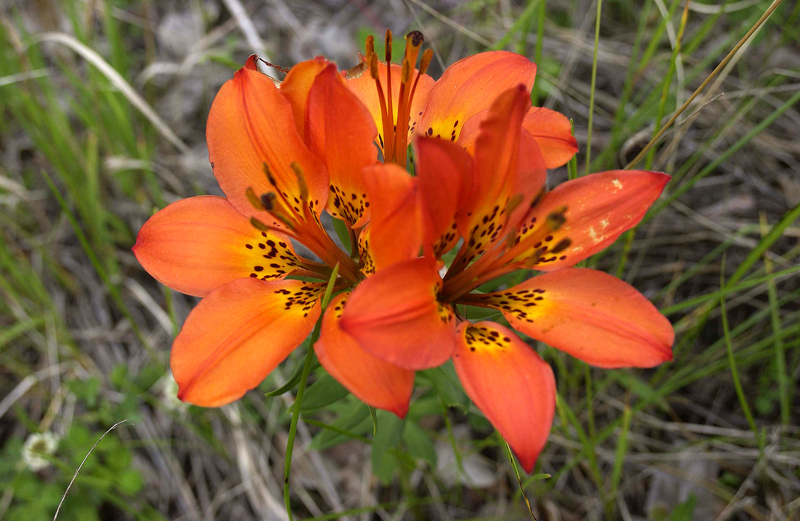
Of the twenty plus lilies that are native to North America, the Wood Lily, sometimes called the Chalice-cup Lily, has the widest range, and yet I’d never encountered one. That is, until I accidently came across one in British Columbia. Several years later I found another one in Washington even though it does not naturally occur there. A lily of moderate height, it appears to be more robust than the Columbia or Tiger Lily whose flowers hang downward. The Wood Lily is our only native lily that has flowers that point upwards.
Deer and rabbits feed on this colorful flower, but for some reason it is toxic to cats and can seriously damage the liver. Even if a cat should rub against its blossoms and get pollen on its fur, this can be harmful. Dogs, on the other hand, seem to not be affected.
The species portion of its Latin name, Lilium philadelphicum, can be translated ‘beloved brother’, and rather than making a reference to the Apostle John, is a botanical allusion to the physical closeness of the stamens to one another.
Unfortunately, this lily has become rather rare, in part due to those who admire its flower and pick it close to the ground. This removes virtually all of its leaves which supply the bulb with nutrients, causing the plant to die. We’re reminded of how the Lord faithfully supplied the Children of Israel with manna while they spent forty years in the wilderness, and yet the day after they entered the Promised Land and ate produce from that land, the manna stopped. (Joshua 5:12) Living responsibly means wisely using the provisions God has provided, and being grateful whether it be for the manna or lilies.